April 2026 · 5 min read
The "AI PM" Title is Broken. Here's What's Actually Coming.
Half the market wants a PM who builds AI. The other half wants a PM who uses AI. Same two words, completely different jobs.
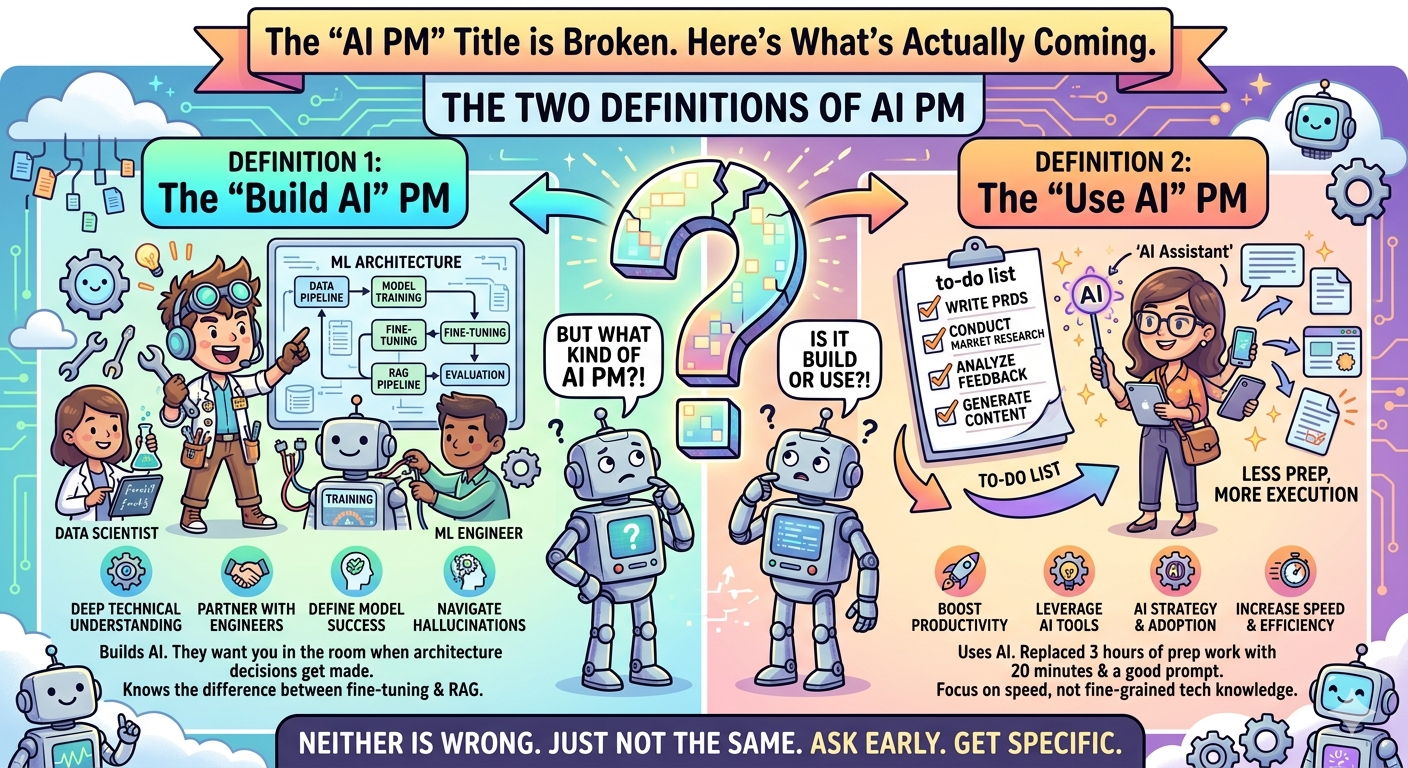
Scroll through any job board right now and you'll see the same two words everywhere: AI PM.
It sounds like one thing. It isn't.
I've been watching this play out in hiring conversations, in Slack threads, in how companies write job descriptions. And honestly? It's kind of maddening. Because everyone is using the same two words and nobody is talking about the fact that they mean completely different things depending on who's typing them.
So let's just say it.
Half the market wants a PM who builds AI. They want someone who can talk to an ML engineer without a translator. Someone who knows the difference between a fine-tuned model and a RAG pipeline. Someone who can look at a hallucinating output and say "this is a retrieval problem, not a model problem." They want you in the room when architecture decisions get made, not just in the room for the roadmap review.
The other half wants a PM who uses AI. Someone who figured out how to do the same job in half the time. Better PRDs, sharper research, faster decisions. The PM who replaced three hours of prep work with twenty minutes and a good prompt. They don't need you to understand transformers. They just need you to move faster.
Neither version is wrong. Both are real jobs worth doing.
But they are not the same person. And when a job description says "AI PM" without being clear about which one they mean, you are walking into that interview with a 50/50 chance of answering the wrong question really well. That is a frustrating place to be.
Why This Confusion Exists
Two years ago, "AI Product Manager" mostly meant you were working on a product that had some machine learning under the hood. A recommendation engine. A fraud detection model. Smart search. It was a niche. Most PMs weren't touching it.
Then generative AI happened. And suddenly every company needed an AI strategy. Every PM needed an opinion. Every job description needed to signal that they were building something modern.
So "AI PM" became a catch-all. A shorthand. A password almost. Something you drop into the conversation to signal you're in the right category, and hope whoever's on the other side meant the same thing.
Most of the time, they didn't.
What This Means If You're Job Hunting (or Hiring)
If you're job hunting right now, do yourself a favour and ask the clarifying question early. Don't assume you know which "AI PM" they mean. Just ask: "When you say AI PM, are you looking for someone building the AI capabilities, or someone building strategy and adoption around AI you've already built?"
That one question will tell you more about the role than the next three rounds of interviews.
And if you're hiring, please, get specific. "AI PM" is too broad. Your candidate pool will thank you.
The Bottom Line
The title is broken for now. That's okay. Language always lags reality, especially in a space moving this fast. But the skill set underneath it is real. And the people who can genuinely do both are rare and getting rarer to find as demand goes up.
The job description will catch up eventually.
For now the most important thing is knowing which version of that job you're actually walking into.